Hope the following information will help to understand clear about fragmentation and re-assembly.
Fragmentation
When a router receives a packet, it examines the destination address and determines the outgoing interface to use and that interface's MTU. If the packet size is bigger than the MTU, and the Do not Fragment (DF) bit in the packet's header set to 0; the router may fragment the packet.The router divides the packet into segments. The max size of each segment is the MTU minus the IP header size (20 bytes minimum; 60 bytes maximum). The router puts each segment into its own packet, each fragment packet having following changes:
- The total length field is the segment size.
- The more fragments (MF) flag is set for all segments except the last one, which is set to 0.
- The fragment offset field is set, based on the offset of the segment in the original data payload. This is measured in units of eight-byte blocks.
- The header checksum field is recomputed.
It is possible for a packet to be fragmented at one router, and for the fragments to be fragmented at another router. For example, consider a packet with a data size of 4,500 bytes, no options, and a header size of 20 bytes. So the packet size is 4,520 bytes. Assume that the packet travels over a link with an MTU of 2,500 bytes. Then it will become two fragments:
| Fragment | Total bytes | Header bytes | Data bytes | "More fragments" flag | Fragment offset (8-byte blocks) |
|---|---|---|---|---|---|
| 1 | 2500 | 20 | 2480 | 1 | 0 |
| 2 | 2040 | 20 | 2020 | 0 | 310 |
Note how we get the offsets from the data sizes:
- 0.
- 0 + 2480/8 = 310.
| Fragment | Total bytes | Header bytes | Data bytes | "More fragments" flag | Fragment offset (8-byte blocks) |
|---|---|---|---|---|---|
| 1 | 1500 | 20 | 1480 | 1 | 0 |
| 2 | 1020 | 20 | 1000 | 1 | 185 |
| 3 | 1500 | 20 | 1480 | 1 | 310 |
| 4 | 560 | 20 | 540 | 0 | 495 |
Note how we get the offsets from the data sizes:
- 0.
- 0 + 1480/8 = 185
- 185 + 1000/8 = 310
- 310 + 1480/8 = 495
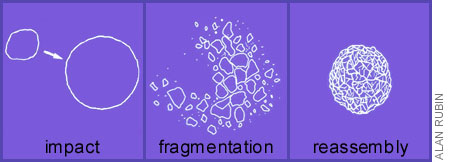 |
| Fragmentation & Re-assembly |
Reassembly
A receiver knows that a packet is a fragment if at least one of the following conditions is true:- The "more fragments" flag is set. (This is true for all fragments except the last.)
- The "fragment offset" field is nonzero. (This is true for all fragments except the first.)
When the receiver has all the fragments, it can put them in the correct order, by using their offsets. It can then pass their data up the stack for further processing.
****Thanks to Wikipedia****

No comments:
Post a Comment